Forrester Finds AI Governance Lacking In Enterprise Strategy
AI governance is not fully integrated into enterprise AI plans, according to Forrester, which may hinder its potential, Forrester reported that many organizations have AI policies but lack a comprehensive governance strategy
Original reporting · forrester.com
Original: “AI Governance Has A Strategy Problem”
Read “AI Governance Has A Strategy Problem” at Forrester →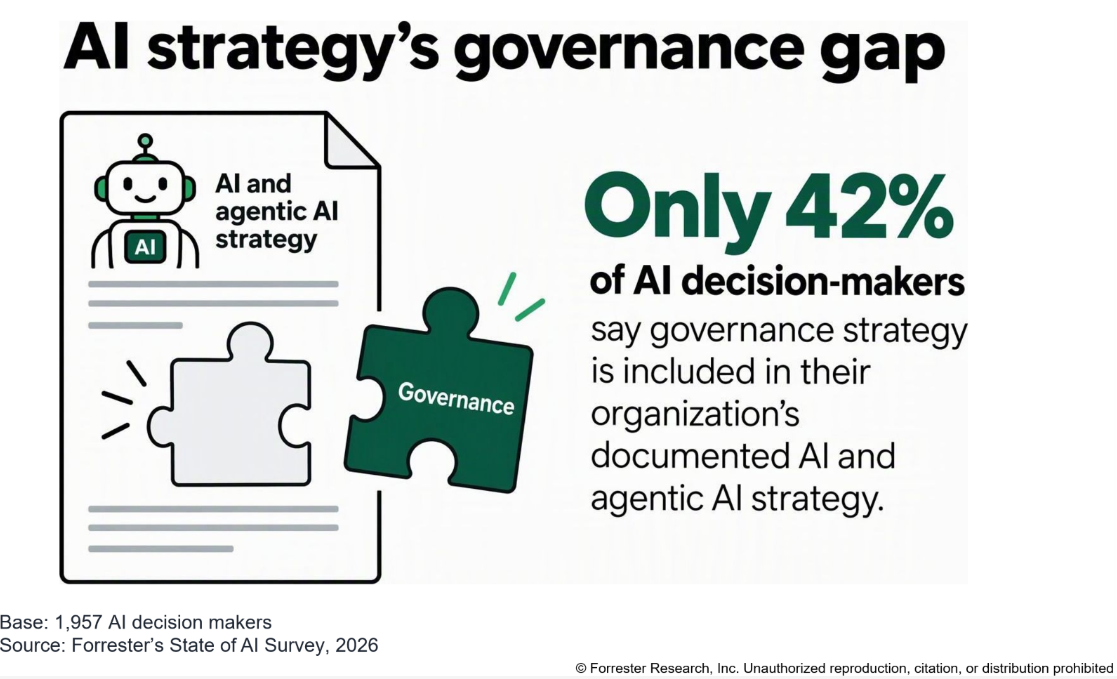
How this was written. Message Verified wrote this article with a language model from Forrester’s reporting (model: @cf/meta/llama-3.3-70b-instruct-fp8-fast); it describes that reporting rather than adding to it. The original, linked above, is the full story.
Key points from Forrester’s report
- AI governance is not yet fully integrated into enterprise AI strategy, according to Forrester.
- Many organizations have AI policies, but lack a comprehensive governance strategy.
- Effective governance is critical to ensuring that AI remains a valuable asset rather than a liability.
- The increasing use of autonomous AI agents raises the stakes for governance.
- Good governance focuses on outcomes rather than just outputs.
Forrester's latest data indicates that AI governance has become a priority for enterprises, but it still has a long way to go in terms of strategic integration. Many organizations have begun to develop AI policies, but these efforts are often fragmented and lack a cohesive governance strategy. As a result, AI governance is not yet deeply embedded in enterprise AI strategy.
The challenge for chief technology officers and chief artificial intelligence officers is to move beyond simply governing AI use and instead build governance into the entire AI lifecycle. This includes how the enterprise buys, builds, deploys, and scales AI. Effective governance is critical to ensuring that AI remains a valuable asset rather than a liability.
Having individual AI policies is a good starting point, but it is not enough to constitute a comprehensive governance strategy. As enterprises scale their AI efforts, they need a repeatable approach to decision-making, including which use cases to invest in, what risks to accept, and what protections to establish. AI decision-makers must also determine who can approve deployments and where human oversight is necessary.
The increasing use of autonomous AI agents, also known as agentic AI, raises the stakes for governance. These agents can access enterprise data, execute business processes, and interact with external applications, creating new governance challenges. Organizations must govern not only what these systems produce but also what they can do, what they can access, and when humans should intervene.
A governance strategy defines what an organization intends to govern, why, and according to which principles and policies. However, having a strategy is not the same as governing AI effectively. Organizations must translate their governance strategy into action through decisions, processes, and controls that shape how AI is built, bought, deployed, and used.
To achieve good governance, enterprises should focus on outcomes rather than just outputs. They should design governance for action, not just review and compliance. This includes defining authority, access, oversight, and escalation before AI agents enter critical workflows. It also means extending the same requirements to AI acquired from suppliers and treating AI literacy as a governance capability.
Forrester clients can explore the full trends and insights on AI governance, including how enterprises are strengthening their governance strategies and connecting them with AI outcomes and workforce readiness. This research provides valuable guidance for organizations seeking to improve their AI governance and ensure that AI remains a valuable asset.
Questions and answers
What is the current state of AI governance in enterprises?
AI governance is not yet fully integrated into enterprise AI strategy, with many organizations lacking a comprehensive governance strategy.
Why is effective governance critical for AI?
Effective governance is critical to ensuring that AI remains a valuable asset rather than a liability, by providing a framework for decision-making and risk management.
How can enterprises achieve good governance for AI?
Enterprises can achieve good governance by focusing on outcomes, designing governance for action, and extending requirements to AI acquired from suppliers, as well as treating AI literacy as a governance capability.